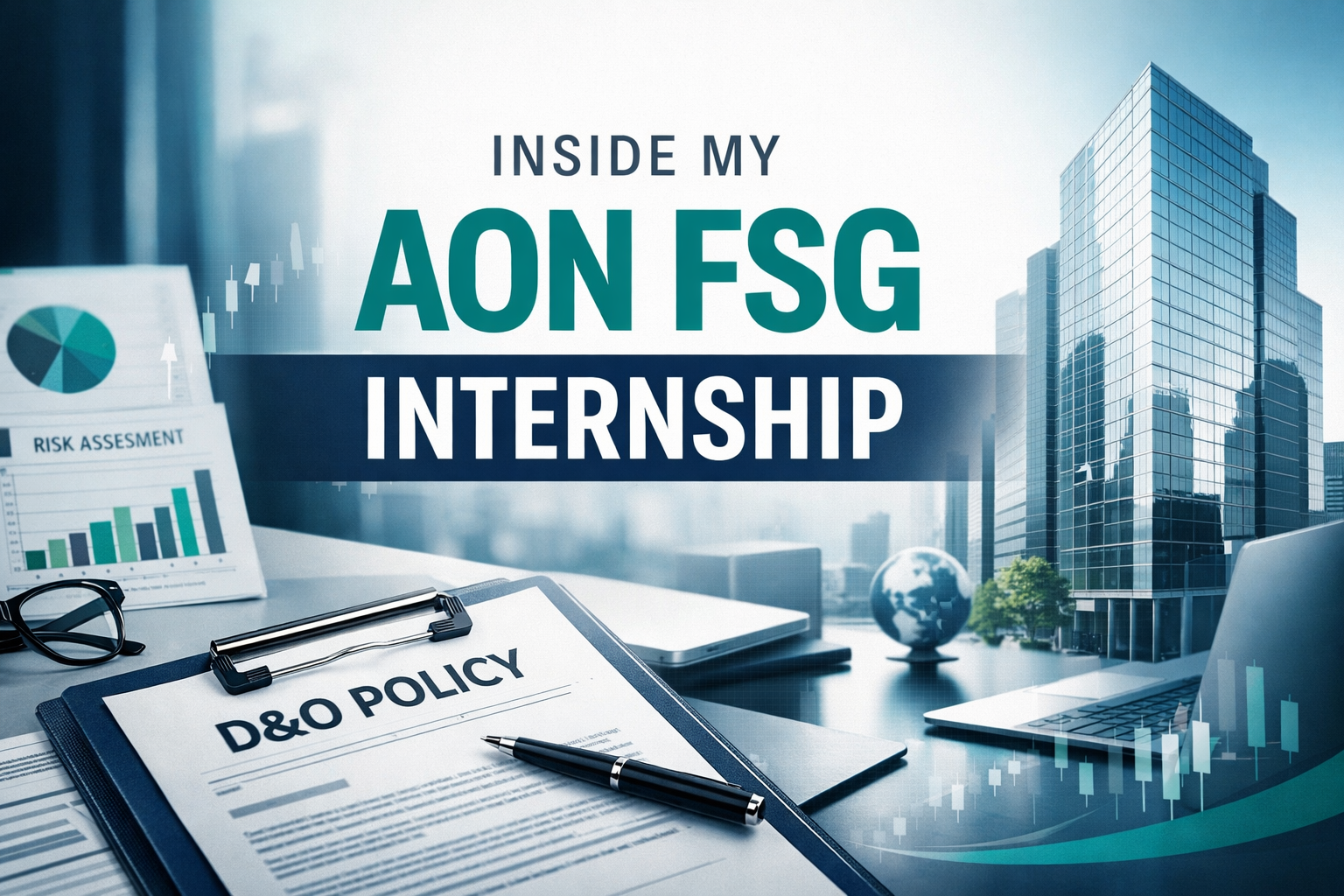
When people hear "insurance," they usually think about car policies or health plans. Before my internship at Aon's Financial Services Group (FSG), that's honestly where my understanding ended too.
But stepping into the world of corporate insurance broking opened an entirely different side of finance—one focused not on chasing returns, but on protecting companies from catastrophic risk.
And once you see how that system works, you start realizing how essential it is to the global economy.
The Role of a Broker in Corporate Insurance
At a high level, Aon acts as an insurance broker and advisor.
Companies don't usually go directly to insurers when they need complex coverage. Instead, they work with brokers who understand both the client's risk profile and the insurance market.
The broker's job is to:
- Understand the client's financial and operational risks
- Design an insurance program to protect against those risks
- Negotiate with insurers to place coverage
Think of brokers as architects of risk protection.
My Exposure to Directors & Officers (D&O) Insurance
One of the most interesting areas I worked with was Directors & Officers (D&O) insurance.
D&O insurance protects corporate executives and board members if they're sued over decisions made while managing a company.
For example, lawsuits might involve:
- Shareholder disputes
- Regulatory investigations
- Corporate governance claims
Without this type of insurance, executives could face enormous personal financial liability.
That's why D&O is considered one of the most important forms of coverage for public companies.
What I Actually Did During the Internship
A big part of my role involved supporting the broking team as they prepared insurance programs for clients.
Some of my responsibilities included:
Financial Analysis of Clients
Before placing insurance, brokers analyze the financial condition of a company.
This might involve reviewing:
- Revenue trends
- Debt levels
- Industry risk exposure
- Corporate governance structures
Understanding the financial health of a company helps insurers determine how risky it is to provide coverage.
Building Insurance Program Structures
Large companies rarely rely on a single insurance policy.
Instead, they build layered insurance programs.
For example:
- Primary coverage layer
- Excess coverage layers
- Additional specialty coverage
Each layer may come from a different insurer.
Part of the broking process involves coordinating those layers so the client receives complete protection.
Working with Underwriters
Insurance underwriters are the professionals who decide whether a risk is acceptable and what premium should be charged.
During my internship I saw how brokers and underwriters collaborate.
- Brokers advocate for their clients.
- Underwriters evaluate the risk.
The negotiation between those two sides ultimately determines the final insurance program.
What Surprised Me About the Insurance Industry
Before this experience, I didn't fully appreciate how deeply insurance is connected to the broader financial system.
Insurance makes many economic activities possible.
- Companies can raise capital more easily when risks are insured.
- Executives are more willing to make decisions when liability protection exists.
- Large projects move forward because catastrophic risks are covered.
In many ways, insurance acts as a hidden stabilizer of modern economies.
The Human Side of Risk
Another thing I noticed quickly: the insurance business is extremely relationship-driven.
Despite all the financial analysis and policy structures, deals often come down to trust between:
- Clients
- Brokers
- Underwriters
That human element reminded me that finance is never purely mathematical.
It's about people making decisions under uncertainty.
What I Took Away from the Experience
My time at Aon helped me understand that finance isn't only about investments or markets.
It's also about risk management.
Every company faces uncertainty. Insurance is one of the key tools used to manage that uncertainty.
Seeing how those systems work behind the scenes was an experience I'll carry forward in my finance career.